

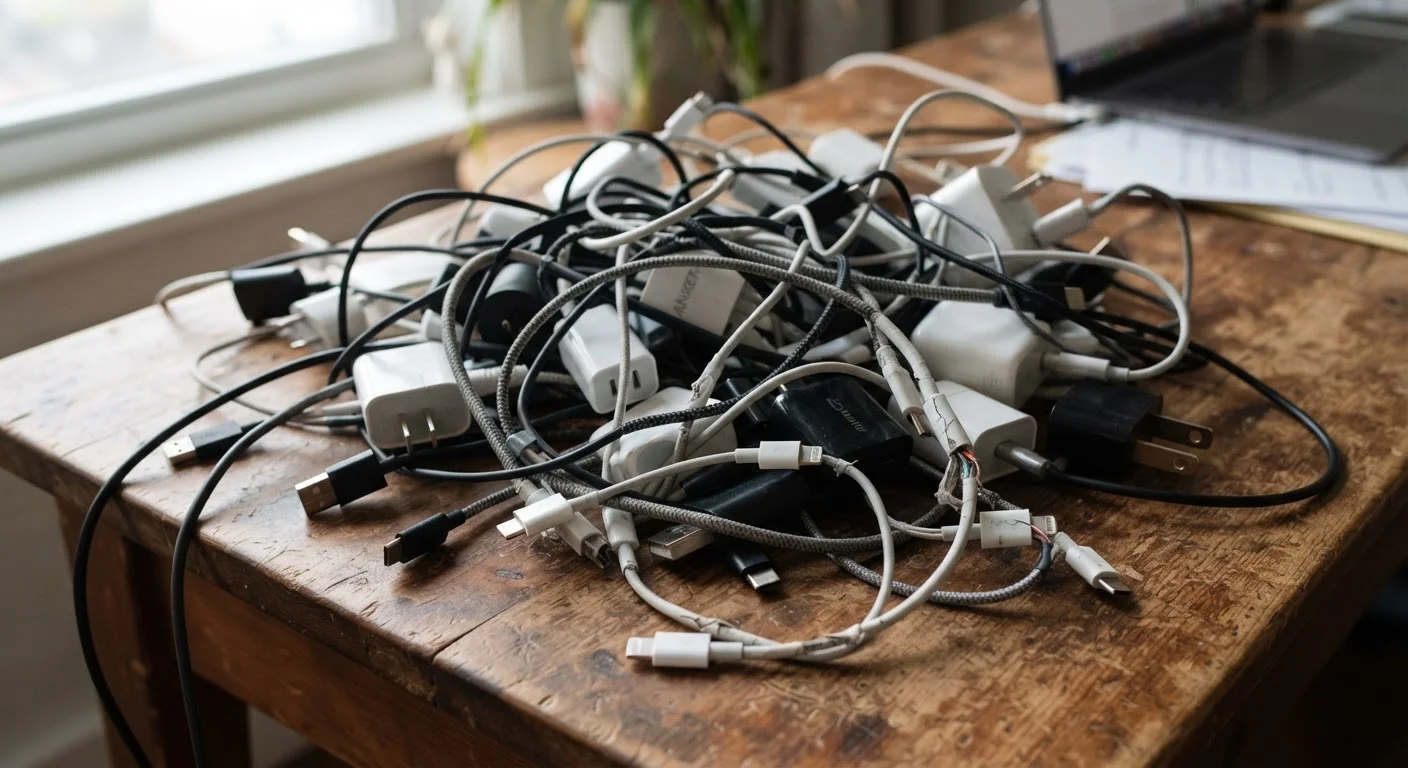
What makes a charger 'cheap' in the technical sense
Price alone does not define a poor-quality charger. The real issue is whether the internal components meet the voltage, current, and thermal management requirements of your device. A well-made charger regulates output so the power delivered stays within the range the device expects. A poorly made one may output unstable voltage, skip safety circuits, or use materials that degrade quickly under heat stress.
Independent safety certification is the clearest signal available to consumers. In the United States, listings from testing organizations such as UL (Underwriters Laboratories) or compliance with USB-IF (USB Implementers Forum) standards indicate the product has been evaluated against defined safety benchmarks. Chargers without any such marking have not gone through that process, regardless of what the packaging claims.
Cables carry similar risks. Thin internal wiring raises resistance, which generates heat during charging. Poor insulation around the connector joint is where most visible damage starts, and it is also where electrical faults are most common.
Common mistakes people make with charging accessories
Using a charger with no safety certification because it came with a low-cost device or was sold loosely in a discount bin.
Why it happens: These chargers often look identical to certified ones and are sold alongside legitimate accessories. Without a visible UL listing or USB-IF compliance mark, there is no external cue that the product skipped safety testing.
Continuing to use a cable that has visible fraying near the connector or a jacket that feels hot during charging.
Why it happens: Cables degrade gradually, and the early signs of damage, slight stiffness, minor discoloration at the connector, are easy to dismiss as cosmetic. People often wait until a cable stops working entirely before replacing it.
Assuming a charger is compatible because the plug physically fits the port.
Why it happens: USB-C connectors are now used across a wide range of devices with very different power requirements. A connector fitting does not mean the charger delivers the correct wattage or supports the same fast-charging protocol the device uses.
Leaving uncertified chargers plugged in and unattended overnight, especially in bedrooms.
Why it happens: Overnight charging is a common habit because it is convenient, and most of the time nothing goes wrong. This creates a false sense that the accessory is safe.
Buying multi-port charging hubs at very low prices without checking total power output.
Why it happens: A hub with four ports appears to offer four simultaneous charges, but the total wattage is sometimes divided unevenly or capped below what any individual device needs to charge at full speed.
Understanding where these errors come from makes them easier to avoid. For more on how charging habits interact with long-term battery condition, see Smartphone Battery Health: What Drains It Faster Than You Think.
The financial logic behind spending a little more
$50-$100
Typical smartphone battery replacement cost
Repair shops across the U.S. commonly charge within this range for out-of-warranty battery replacement, depending on the device model.
~30%
Battery capacity loss threshold triggering replacement
Most device manufacturers and repair guidelines cite a drop to roughly 70-80% of original capacity as the point where users notice meaningfully shorter battery life.
Battery replacements for smartphones commonly cost between $50 and $100 at a repair shop, and that figure does not account for data backup, device downtime, or the possibility that the repair voids remaining warranty coverage. A certified cable or charger from a reputable manufacturer typically costs $15 to $30. The arithmetic is straightforward.
Warranty coverage adds another layer. Most device manufacturers specify in their warranty terms that damage caused by non-approved accessories is excluded. If a malfunctioning charger causes a charging port failure, the repair bill is the owner's responsibility. That exclusion is standard, not exceptional.
If you are already weighing whether a damaged device is worth repairing or replacing, the repair vs. replace decision involves more factors than just the cost of a new charger, but accessory-related damage is one of the more preventable reasons a device ends up in that situation.
Families traveling by car should also consider that a low-quality car charger used on a road trip creates the same risks as one used at home. See Road Trips on a Family Budget: What Actually Keeps Costs Down for broader guidance on keeping electronics costs manageable while traveling.
The content provided on our blog site traverses numerous categories, offering readers valuable and practical information. Readers can use the editorial team’s research and data to gain more insights into their topics of interest. However, they are requested not to treat the articles as conclusive. The website team cannot be held responsible for differences in data or inaccuracies found across other platforms. Please also note that the site might also miss out on various schemes and offers available that the readers may find more beneficial than the ones we cover.