

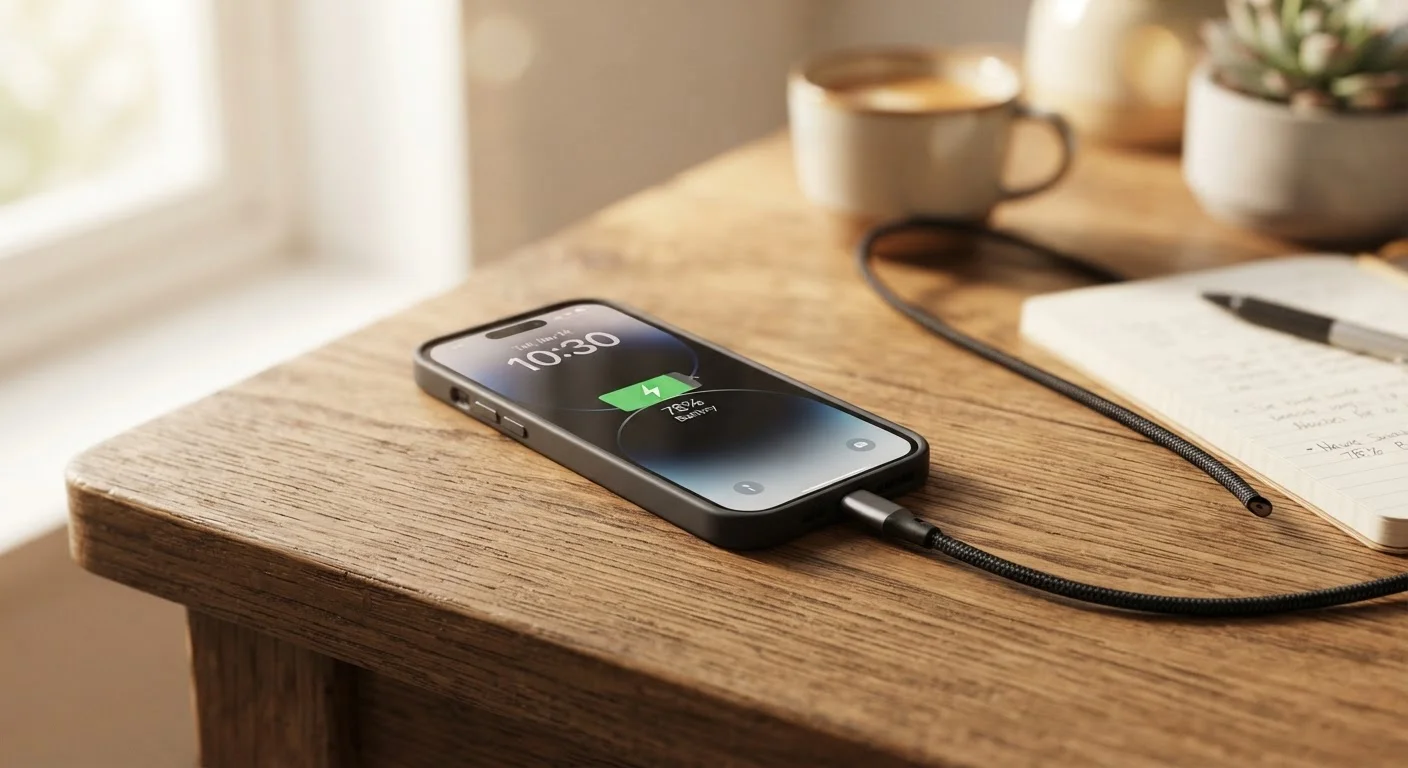
Why battery health myths spread
Lithium-ion batteries power almost every smartphone sold today, yet the advice circulating about how to protect them is a mix of outdated rules from older battery chemistry and outright fiction. Understanding what actually degrades a lithium-ion cell helps you make practical choices without overthinking every charge cycle.
The habits that extend the life of household electronics often apply to your phone too, but battery health has its own specific science worth knowing.
Myth
You should fully drain your battery to zero before charging it again.
Fact
Full discharge cycles accelerate lithium-ion battery wear. Partial top-ups are healthier.
The "drain to zero" rule came from nickel-cadmium (NiCd) batteries, which suffered from a memory effect that lithium-ion cells do not have. Discharging a lithium-ion battery to zero repeatedly puts the cell under higher chemical stress than keeping it in a moderate charge range. Most battery engineers describe the sweet spot as somewhere between 20% and 80% for daily use.
Myth
Leaving your phone plugged in overnight will ruin the battery.
Fact
Modern smartphones use charging management circuits that stop drawing current once the battery is full.
Current iPhones and most Android flagships include hardware and software that taper the charge rate and, in many cases, pause charging at 80% until shortly before you typically wake up. Overnight charging on a certified charger is not the risk it once was. The real concern is heat generated during charging in a poorly ventilated space, not the duration of the connection.
Myth
Closing all background apps constantly saves significant battery life.
Fact
Force-closing apps often uses more power than leaving them suspended in memory.
When an app is suspended in the background, it is largely frozen and consuming very little power. Relaunching it from scratch requires the CPU to load data, rebuild the interface, and re-establish network connections, all of which draw more energy than a brief suspension. Background refresh settings do consume some power, but those are toggled in settings independently of force-closing apps. Closing apps repeatedly is a habit that feels productive without delivering meaningful battery savings.
Myth
Fast charging is always worse for your battery than slow charging.
Fact
Fast charging designed for your specific phone model is generally safe when used with certified accessories.
Phone manufacturers engineer their fast-charging systems to manage heat and voltage carefully. The charging circuit slows down as the battery approaches full capacity to protect the cell. The greater risk comes from using uncertified third-party chargers that claim fast-charging speeds but lack the proper communication protocols with your phone's battery management system. A certified charger matched to your phone's specifications is safer than a cheap generic charger at any speed.
Myth
Battery percentage shown on screen is an exact, real-time measurement.
Fact
Battery percentage is an estimate calculated by the phone's software, not a direct voltage reading.
The battery management system infers charge state from voltage, temperature, and historical data. This is why sudden drops or jumps in percentage sometimes appear, especially in cold weather or on an older battery with uneven cell wear. Calibration drift is normal, and the phone continuously adjusts its estimates. Seeing the percentage jump from 15% to 5% suddenly usually points to an aging battery that has lost capacity, not a software bug.
The factors that genuinely matter
Among all the variables that affect battery longevity, heat is the most damaging. A phone left in a hot car, used while charging during a CPU-intensive task, or placed inside a thick insulating case during heavy use will degrade its battery faster than almost any charging habit. Lithium-ion cells lose capacity measurably faster when consistently stored or operated above 35 degrees Celsius, according to battery chemistry research published by institutions including the Idaho National Laboratory.
Charge level matters too. Most lithium-ion batteries experience less chemical stress when held between roughly 20% and 80% state of charge. Manufacturers including Apple and some Android phone makers have added features to limit charging to 80% precisely because of this. Full 0-to-100% cycles accelerate wear compared to partial cycles.
Charger quality is another real concern. Uncertified chargers and cables carry real risks, including inconsistent voltage delivery that can stress battery cells over time. Cables and chargers carrying recognized safety certifications deliver power within tighter tolerances.
35 C
Temperature above which battery aging accelerates
Idaho National Laboratory and battery chemistry literature consistently identify temperatures above 35 degrees Celsius as the threshold where lithium-ion capacity loss increases meaningfully.
20-80%
Charge range that reduces cell stress
Battery management guidance from multiple smartphone manufacturers cites this partial-charge range as the most protective for daily lithium-ion use.
Background apps do consume some battery, but their share is small compared to screen brightness, cellular radio activity, and location services running continuously. Closing apps compulsively rarely produces meaningful gains and can actually force the phone to reload them from scratch, using more power than leaving them in memory.
Practical habits worth adopting
You do not need to obsess over every percentage point. A few consistent habits protect battery health without disrupting normal phone use. Remove thick cases during extended gaming or video streaming sessions if the phone feels warm. Use your phone's built-in battery health tools, available in settings on most modern iOS and Android devices, to monitor capacity over time. If your phone supports an optimized or adaptive charging mode, enable it.
When you are evaluating a phone for the whole family, battery longevity is a real cost factor. A phone that holds 80% of its original capacity after two years costs less in replacements or battery service fees than one that degrades faster. The questions worth asking before buying any device include whether the manufacturer provides battery replacement options at a reasonable cost.
The content provided on our blog site traverses numerous categories, offering readers valuable and practical information. Readers can use the editorial team’s research and data to gain more insights into their topics of interest. However, they are requested not to treat the articles as conclusive. The website team cannot be held responsible for differences in data or inaccuracies found across other platforms. Please also note that the site might also miss out on various schemes and offers available that the readers may find more beneficial than the ones we cover.