

Why mental enrichment matters as much as the food bowl
Pet owners tracking annual expenses often find that food, veterinary care, and supplies dominate the budget. What rarely appears on the spending list is mental enrichment, yet the absence of it carries real costs. Pets that do not get enough cognitive stimulation are more likely to develop destructive chewing, excessive barking, compulsive grooming, or anxiety, all of which can lead to veterinary visits that are far more expensive than a cardboard box and some kibble. Our annual cost breakdown by animal shows how veterinary expenses can add up quickly, making prevention genuinely worth pursuing.
The good news is that enrichment does not require a specialty toy budget. Animal behavior research consistently shows that the act of working for food, solving a problem, or exploring a novel environment activates reward pathways in a pet's brain in ways that passive living simply does not. The ideas below are grounded in that principle and are designed to work for families spending carefully.
Turn mealtime into a foraging activity
Scatter feeding is one of the simplest and most effective enrichment methods available. Instead of placing a dog's or cat's meal in a bowl, spread dry kibble across a textured surface such as a grass mat, a folded towel, or a snuffle mat made from fleece strips woven through a rubber mat with holes. Small animals like rabbits and hamsters benefit from having pellets hidden in hay rather than placed in a dish.
The cognitive effort of finding food mimics natural foraging behavior and slows eating, which also helps with digestion. A basic fleece snuffle mat takes about 30 minutes to make from materials available at fabric stores, and it can last years with occasional washing.
Scatter feeding turns every meal into a problem-solving session that costs almost nothing extra.
Build puzzle feeders from cardboard and recycled containers
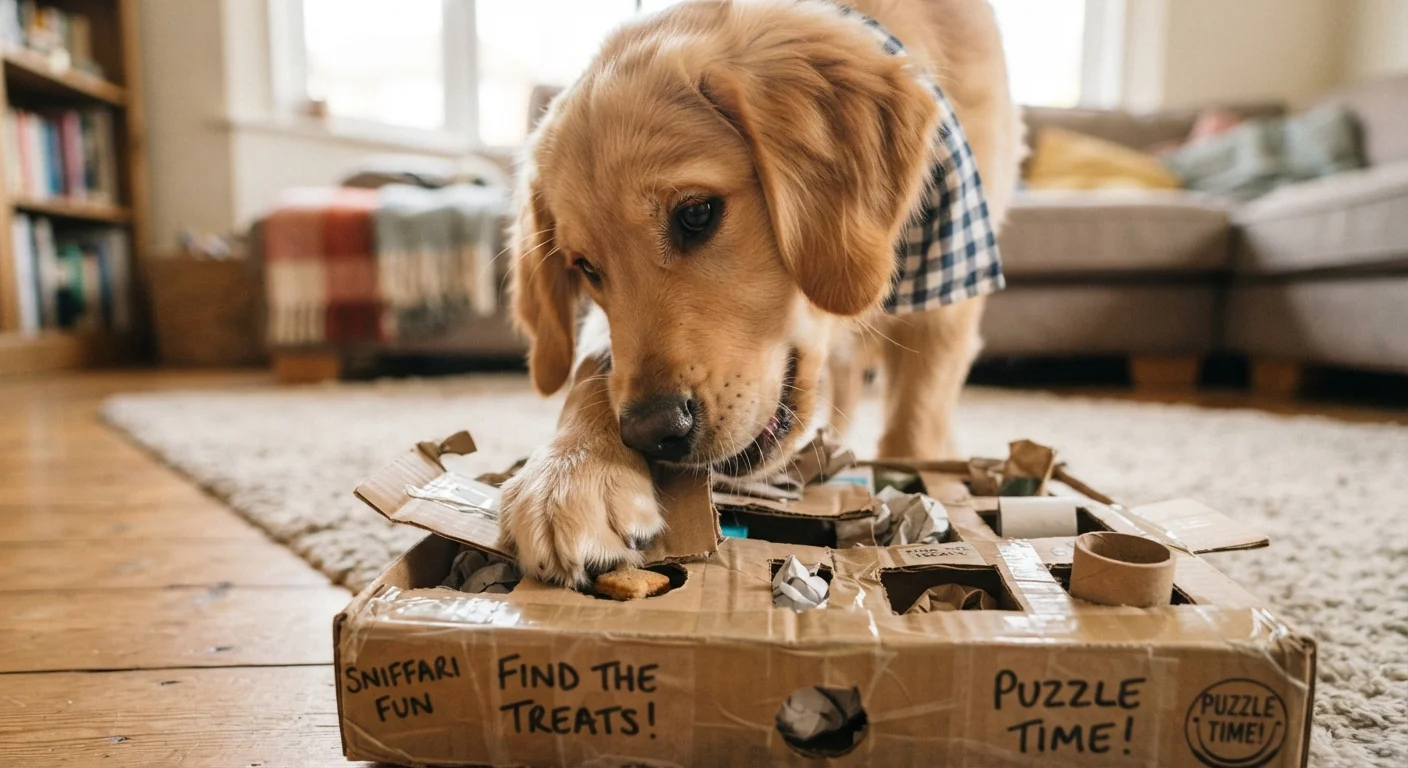
Cardboard tubes from paper towels, small cardboard boxes, and empty plastic bottles with the labels removed can all become food puzzles. Fold the ends of a cardboard tube, put a few pieces of kibble inside, and hand it to a dog or cat. Place several small boxes inside a larger box with treats hidden under some of them and let your pet work out which ones to tip or paw open.
Increasing difficulty over time is straightforward: seal the tube, tape the boxes shut, or add layers. Pets that master one configuration can graduate to more complex arrangements using the same household materials. This approach is consistent with how certified professional trainers use graduated food puzzles to build problem-solving confidence in shelter animals.
Cardboard tubes and small boxes become graduated puzzles that build a pet's problem-solving confidence.
Use training sessions as mental exercise
Ten minutes of reward-based training tires a dog's brain more than a longer, aimless walk. Teaching a sit, stay, or recall from scratch uses up cognitive energy that might otherwise go toward destructive behavior. Cats, rabbits, and even rats can learn to respond to cues using small food rewards, a fact backed by decades of animal learning research.
Training does not require classes or paid programs. Free instructional content from certified trainers is widely available through libraries and online platforms. The only cost is a few minutes per day and a small portion of your pet's regular food measured out as rewards rather than given freely in the bowl.
A ten-minute training session uses more cognitive energy than a longer walk with no mental demands.
Introduce controlled novelty through scent
Scent work is one of the highest-value enrichment activities for dogs and cats because smell is their primary sense for exploring the world. Hiding a few pieces of kibble or a favorite treat inside a crumpled paper bag, under an upturned plastic cup, or inside a muffin tin covered with tennis balls gives pets a genuine olfactory challenge without requiring any purchased gear.
Cats respond well to small amounts of dried catnip or silver vine placed inside a folded piece of fabric. Rabbits and guinea pigs benefit from fresh herbs such as parsley or cilantro tucked into cardboard tubes or hidden in hay. Scent-based activities can be set up in minutes and dismantled immediately after use.
Scent-based searches give pets a genuine cognitive workout using nothing more than paper bags and food.
Create safe exploration zones indoors
Novel environments stimulate curiosity even when the space itself is familiar. Rearranging furniture slightly, placing a cardboard box in a new room, or creating a temporary tunnel from a row of chairs draped with a blanket gives cats and small dogs a changed environment to investigate. For small animals such as guinea pigs, a cardboard playpen set up on the floor with a few safe household objects to investigate provides a low-cost free-range period.
Birds benefit from rotating which perches and safe household items (wooden spoons, uncolored wooden blocks, paper cups) are placed in or near their enclosure. The animal behavior principle at work is called neophilia: the natural tendency of many species to investigate novel stimuli. Providing controlled novelty within a safe space channels that drive productively.
Rearranging a single room or adding a cardboard box costs nothing and reactivates a pet's curiosity.
Schedule interactive play with items you already own
Cats do not need expensive wand toys. A shoelace dragged across the floor, a crumpled ball of paper batting across a hard surface, or a small sock knotted around a little filling of crinkled paper produces the same predatory play response as a commercial toy. Dogs can play hide-and-seek, where a family member hides and calls the dog, or tug games using an old rope or twisted fabric.
The difference between a toy that sits ignored and one that holds attention is almost always whether a human is involved in the play rather than what the object costs. Structured interactive play for 10 to 15 minutes twice daily meets a significant portion of most pets' stimulation needs. Families managing food costs carefully may find the same logic useful: see our guide on human food myths for pets for context on what household items are and are not safe to share.
A crumpled paper ball or old knotted sock, used with active human involvement, holds a cat's attention as well as any commercial toy.
Getting started without spending much
The activities listed above can be introduced gradually. Start with one or two that fit your pet's species and temperament, observe what holds their attention, and rotate through options so novelty is maintained. If your pet shows signs of persistent anxiety or stress even with regular enrichment, consult a veterinarian or certified animal behaviorist, since enrichment addresses boredom but is not a substitute for medical or behavioral assessment. For families also managing grocery and household budgets carefully, the strategies in our grocery spending guide apply a similar philosophy: small, consistent changes in how you use what you already have produce meaningful results over time.
Rotate, don't replace
Pets habituate to enrichment items quickly if those items are always available. Putting a toy or puzzle away for a week and reintroducing it often produces the same excited response as something brand new. Keep three or four items in a rotation rather than leaving everything out at once. This approach maintains novelty without any additional spending.
The content provided on our blog site traverses numerous categories, offering readers valuable and practical information. Readers can use the editorial team’s research and data to gain more insights into their topics of interest. However, they are requested not to treat the articles as conclusive. The website team cannot be held responsible for differences in data or inaccuracies found across other platforms. Please also note that the site might also miss out on various schemes and offers available that the readers may find more beneficial than the ones we cover.