

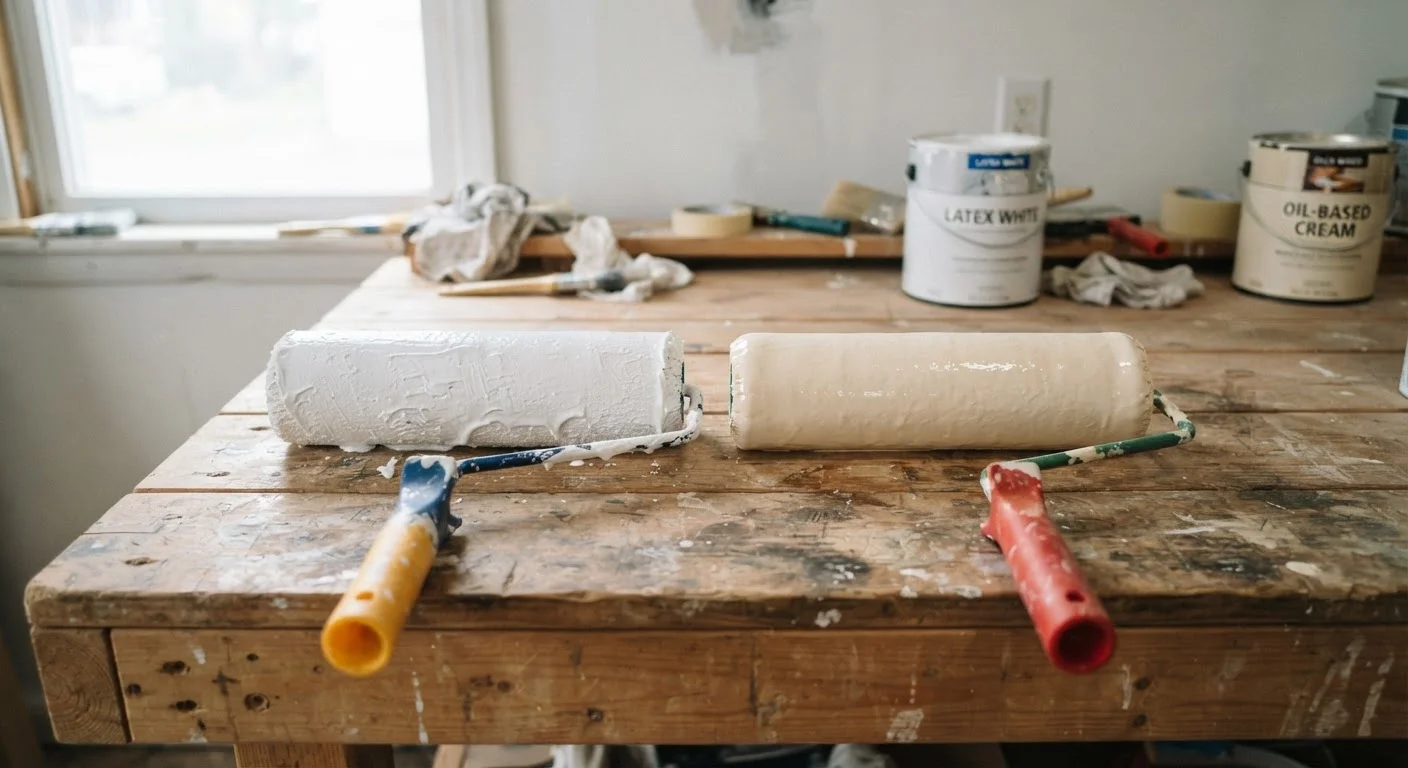
Option A
Latex paint
The practical, fast-drying choice for most interior rooms.
Best for: Homeowners painting walls, ceilings, and low-humidity rooms who want quick cleanup and low odor.
Option B
Oil-based paint
The hard-wearing finish for surfaces that take daily punishment.
Best for: High-traffic trim, doors, and cabinets where a tough, washable surface matters more than dry time.
How each paint type is made and why it matters
Latex paint uses water as its carrier. The pigment and binder (typically an acrylic or vinyl-acrylic resin) are suspended in water and dry when the water evaporates. Because the chemistry is water-based, the paint stays flexible after curing and does not yellow over time.
Oil-based paint uses a petroleum-derived solvent (usually mineral spirits or naphtha) as its carrier, with an alkyd or linseed oil binder. As the solvent evaporates and the binder oxidizes, the paint forms a very dense, hard film. That hardness is what makes oil-based paint stand up to repeated washing and physical contact on trim and woodwork.
The practical implication is this: the binder chemistry determines dry time, cleanup method, VOC output, and long-term flexibility. Water-based latex stays slightly more flexible through temperature changes, so it resists cracking on walls that expand and contract seasonally. Oil-based paint becomes rigid, which works well on stable surfaces like wood trim but can lead to brittleness on plaster walls over decades.
| Criterion | Latex paint | Oil-based paint |
|---|---|---|
| Dry time between coats | 1 to 2 hours | 8 to 24 hours |
| Cleanup method | Soap and water | Mineral spirits or paint thinner |
| VOC level | Low to moderate | High (solvent-based) |
| Hardness of cured film | Moderate, flexible | Hard, rigid |
| Yellowing over time | Minimal | Can yellow in low-light areas |
| Best surface use | Walls and ceilings | Trim, doors, cabinets |
| Regulatory availability | Available in all US states | Restricted in some states |
| Self-leveling (brush marks) | Moderate | Good |
Performance in real-world interior conditions
On painted walls in living rooms and bedrooms, latex performs well enough that professional painters now use it almost exclusively for these areas. Modern acrylic latex formulas are scrubbable and hold color without fading.
Humidity is where the formulas diverge most noticeably. Oil-based paint historically had the edge in bathrooms because it repelled moisture better. Manufacturers have since released latex products labeled kitchen and bath that include mildewcide additives and tighter film formation. These are a reasonable option in moderate-humidity bathrooms, though ventilation and surface prep still matter more than the paint label alone.
On trim, baseboards, and doors, the hardness difference is real. Oil-based paint takes more abuse before showing scuffs, and it self-levels as it dries, reducing visible brush strokes. Alkyd-based trim paints (a refined form of oil-based) are common in professional finish work precisely because of that smooth final surface.
50+ g/L
Typical VOC limit for flat interior latex paint
The U.S. Environmental Protection Agency's Architectural Coatings Rule sets VOC limits that vary by sheen level and product category.
8-24 hrs
Recoat wait time for oil-based paint
Most oil-based paint manufacturers specify this range on the label under typical indoor conditions of 70 degrees Fahrenheit and 50 percent relative humidity.
1-2 hrs
Recoat wait time for latex paint
Standard acrylic latex formulas achieve surface dry in 30 to 60 minutes and are ready for a second coat within one to two hours under the same conditions.
VOC content deserves attention in occupied homes. Oil-based paint can emit solvent fumes for several days and requires cross-ventilation. Many states have adopted regulations limiting the VOC content of architectural coatings, and some high-solvent oil-based products are restricted or unavailable in certain markets. Check the label and your local rules before committing to oil-based paint in a room with limited airflow.
Surface prep and application differences
Latex paint goes on with a synthetic-bristle brush or a standard roller and cleans up with warm, soapy water. It is ready for a second coat in one to two hours under normal temperature and humidity. That speed benefits a DIY project where you want to finish a room in a single day.
Oil-based paint requires natural-bristle or China bristle brushes for the smoothest application. Cleanup requires mineral spirits or paint thinner, which adds cost and disposal considerations. Dry time between coats runs eight to twenty-four hours depending on temperature and air circulation. Rushing this step causes the finish to wrinkle or stay tacky.
Painting latex over existing oil-based paint is one of the most common problems homeowners run into. The flexible latex layer will not bond well to the hard, slick oil surface without preparation. The fix is to sand the old surface lightly with 120- to 150-grit sandpaper, wipe off dust, and apply a shellac-based or oil-based bonding primer before the latex topcoat. Skipping any of these steps often leads to peeling within a year or two.
Applying oil-based paint over existing latex is generally not recommended on walls. The rigid oil film can crack as the underlying latex layer expands and contracts. On trim that was previously painted with latex, light sanding and a bonding primer improve adhesion, but the long-term durability of that combination is lower than painting oil on oil or latex on latex.
Cost and practical availability
Latex paint is widely available at all price points and in a full range of sheens, from flat to high-gloss. It is the default option in most hardware and home-improvement stores across the United States.
Oil-based paint costs more per gallon in most markets and has become harder to find in some states due to VOC regulations. Water-based alkyd paints have filled some of that gap. These are water-cleanup products that use an alkyd resin, giving a harder film closer to traditional oil-based paint while meeting lower-VOC requirements. They cost more than standard latex but less than solvent-based oil paint, and they are available where traditional oil-based products are restricted.
For a family budgeting a full-room repaint, latex is almost always the practical starting point for walls and ceilings. Reserve oil-based or water-based alkyd for trim if you want the durability advantage there.
The content provided on our blog site traverses numerous categories, offering readers valuable and practical information. Readers can use the editorial team’s research and data to gain more insights into their topics of interest. However, they are requested not to treat the articles as conclusive. The website team cannot be held responsible for differences in data or inaccuracies found across other platforms. Please also note that the site might also miss out on various schemes and offers available that the readers may find more beneficial than the ones we cover.