

Our Verdict
The debt avalanche is the lower-cost path on paper, but only if you stick with it long enough to reach the high-interest accounts. The debt snowball costs more in interest for most households but tends to produce the visible progress that keeps people on track. For families carrying a wide spread of interest rates across many accounts, avalanche saves real money. For those who have struggled to stay consistent with past payoff attempts, snowball's early account closures can change the behavioral pattern.
| Best for | Recommended |
|---|---|
| Households with multiple high-interest accounts and strong financial discipline | Debt avalanche |
| Those who need quick wins to stay motivated and avoid abandoning the plan | Debt snowball |
| Families with a large interest rate gap between their highest and lowest debts | Debt avalanche |
| Anyone carrying many small balances that create mental clutter | Debt snowball |
How each method works
Both methods share the same mechanical foundation: pay the minimum on every debt, then direct any extra money each month toward one target account.
With the debt avalanche, you rank debts by annual percentage rate (APR) from highest to lowest. Every extra dollar goes to the highest-rate account until it is gone, then you redirect that freed-up payment to the next account down the list. Because high-rate debt accrues the most interest each month, attacking it first shrinks the total interest you pay across the life of all your debts.
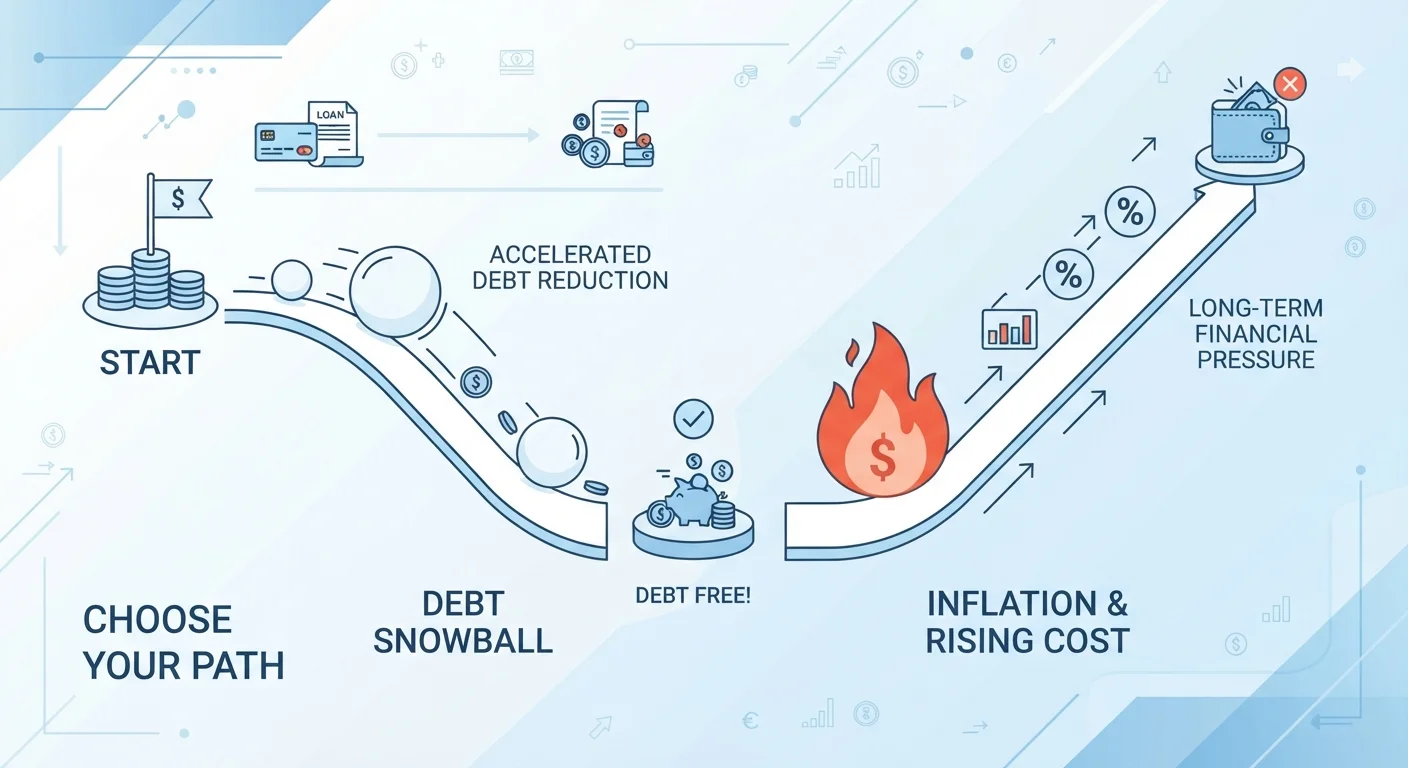
With the debt snowball, you rank debts by outstanding balance from smallest to largest, ignoring the interest rate. Extra payments go to the smallest balance first. When that account is cleared, you roll its former minimum payment into the attack on the next smallest balance. The growing payment on each successive account is what gives the method its name.
A concrete illustration helps. Suppose a household carries three debts: a $500 medical bill at 0% APR, a $3,200 credit card at 22% APR, and a $7,000 personal loan at 11% APR. Avalanche targets the 22% card first. Snowball targets the $500 medical bill first. The order is reversed, and over a multi-year payoff timeline the interest difference between the two approaches can reach several hundred dollars or more, depending on balances and the size of the extra monthly payment.
The math vs. the psychology
| Debt avalanche | Debt snowball | |
|---|---|---|
| Ordering principle | Highest APR first | Smallest balance first |
| Total interest paid | Lower in most scenarios | Higher when small debts carry low rates |
| Time to first account closure | Longer if high-rate debt is large | Faster by design |
| Motivational structure | Relies on patience and discipline | Early wins reinforce habit |
| Best fit | Wide rate spread, consistent payers | Many accounts, past plan dropouts |
| Mathematical complexity | Requires knowing each APR | Only needs current balances |
The avalanche wins the interest calculation every time the highest-rate debt is not also the smallest balance. A 2012 study published in the Journal of Marketing Research by researchers Alexander Chernev and colleagues found that people tend to feel more progress when they can close accounts entirely, regardless of balance size. This is the behavioral logic the snowball method is built on.
The risk with the avalanche is that your highest-rate debt may also carry the largest balance. A family with $14,000 on a high-rate credit card will spend many months paying it down before any account closes. That extended stretch without a visible milestone can erode commitment, which is when people stop making extra payments entirely.
The risk with the snowball is straightforward: if your smallest balance also carries a low interest rate, you are deferring the high-rate debt longest, and the interest on that account continues to grow while you clear cheaper accounts.
Questions to ask before you choose
No single method fits every household. These questions can sharpen the decision:
- How wide is your interest rate spread? If all your debts sit between 18% and 22%, the avalanche produces minimal savings and the snowball's motivational structure may be worth more. If you have a 7% auto loan alongside a 26% store card, the rate gap makes avalanche more compelling.
- How many accounts do you carry? Five or more open accounts, several with small balances, creates administrative and psychological burden. Snowball closes those quickly. Two or three accounts with large balances make the ordering decision matter more financially.
- Have you abandoned a payoff plan before? Be honest. If past attempts stalled, the snowball's design for early momentum is relevant information, not just a consolation prize.
- Can you free up a consistent extra payment? Both methods require a fixed surplus each month. Without one, neither works. Before choosing a method, build that surplus into your budget first.
Lock in your extra payment before choosing a method
The single biggest driver of payoff speed is the size and consistency of your extra monthly payment, not which method you use. Before ranking your debts, review your monthly budget and identify one specific expense you can reduce or eliminate to create that surplus. Transfer it to your target debt on the same day your paycheck arrives so it does not get absorbed by discretionary spending.
This article is general financial information and education, not personalized financial or debt counseling advice. Consider speaking with a nonprofit credit counselor or a licensed financial professional before making significant changes to your debt repayment plan.
Hybrid approaches and practical starting points
Some households use a hybrid: pay off one or two very small accounts with the snowball to reduce monthly complexity, then switch to avalanche order for the remaining larger balances. This is not a formally named strategy, but it reflects how real budgets work. The point is consistency, not purity of method.
A few practical steps apply regardless of which approach you pick. List every debt with its current balance, APR, and minimum payment in one place. Calculate the total minimum payments, then identify how much above that total you can commit each month without borrowing to cover other expenses. Even $50 extra per month applied consistently changes the payoff timeline for most household debt loads. Once the first account is cleared, redirect its entire former payment (minimum plus the extra) to the next target rather than spending that freed-up cash elsewhere. That redirection is what produces the compounding effect both methods rely on.
The content provided on our blog site traverses numerous categories, offering readers valuable and practical information. Readers can use the editorial team’s research and data to gain more insights into their topics of interest. However, they are requested not to treat the articles as conclusive. The website team cannot be held responsible for differences in data or inaccuracies found across other platforms. Please also note that the site might also miss out on various schemes and offers available that the readers may find more beneficial than the ones we cover.